Categories
Agriculture and Alternative Livelihood Highlights Youth Intervention Projects

Voice Technology Innovations by Gram Vaani


Voice-based conversational interfaces hold significant potential to build interactive applications, especially for data collection in low-resource settings for low-income & less-literate populations, where users may speak their responses in conversational manner through natural speech.

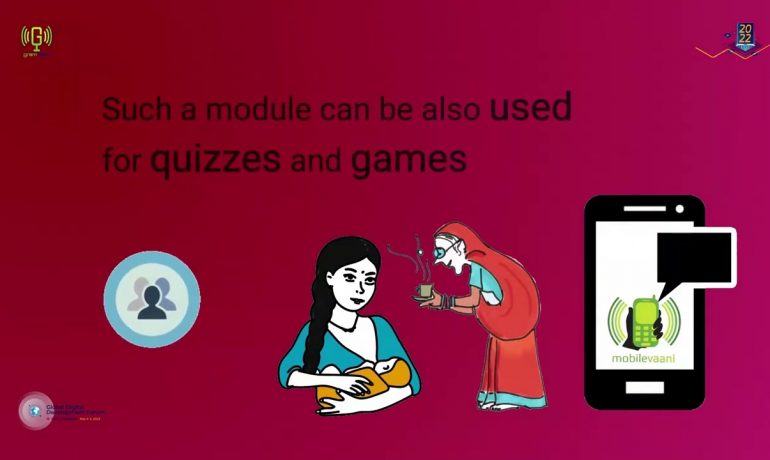
 This video showcases our three new voice-tech innovations  – 1) Voice-enabled Data Collection 2) Voice-enabled Conversational Message d]Delivery or a ‘VoiceBot’ & 3) Automated Voice QnA. All three solutions are accessed through our robust & scale-tested Interactive Voice Response (IVR) platform available over basic feature-phones without the need for internet and smart devices.

Costs and Benefits of Conducting Voice-based Surveys Versus Keypress-based Surveys on Interactive Voice Response Systems – A. Khullar, P. Hitesh, S. Rahman, D. Kumar, R. Pandey, P. Kumar, R. Tripathi, Prince, A.A. Jha, Himanshu, and A. Seth.
ACM COMPASS, 2021.

Experiences with the Introduction of AI-based Tools for Moderation Automation of Voice-based Participatory Media Forums – A. Khullar, P. Panjal, R. Pandey, A. Burnwal, P. Raj, A.A. Jha, P. Hitesh, R.J. Reddy, Himanshu, and A. Seth.
India HCI, 2021.

Early Results from Automating Voice-based Question-Answering Services Among Low-income Populations in India – A. Khullar, M. Santosh, P. Kumar, S. Rahman, R. Tripathi, D. Kumar, S. Saini, R. Pandey, and A. Seth.
ACM COMPASS, 2021.

Initial Lessons from Building an IVR-based Automated Question-Answering System – P. Bhagat, S. Prajapati, and A. Seth.
ICTD, 2020.

Categories
Agriculture and Alternative Livelihood

What can make Direct Benefit Transfers safer for India’s rural citizens?


By Rohan Katepallewar and Vani Viswanathan, Gram Vaani

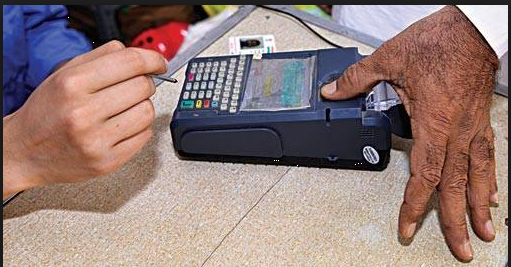
For five years, Arun Lodhiya from Shivpuri, Madhya Pradesh, tried multiple times to withdraw his NREGA wages from his bank account at the local Customer Service Point, which are set up across the country to facilitate last-mile banking services for people in villages. From 2015 to 2020, he only managed to withdraw INR 5,800, his attempts regularly failing despite his thumbprint authentication, as the operator at the CSP said there was insufficient balance in his account or that his account was “blocked”. He was in for a shock when in 2020, he realized that each time he was attempting to withdraw money, the “issues” that had prevented him from withdrawing cash were used as a cover-up to rob him of INR 1 lakh.

Arun is one of hundreds of people who shared their experiences of using India’s physical and digital banking services with Mobile Vaani, our mobile radio platform for people in hard-to-reach communities.

Financial inclusion has been well established as the pathway to alleviate poverty and promote economic development. Acknowledging this fact, the Indian government has been striving for financial inclusion of the masses, while also working to strengthen the physical and digital banking ecosystem. The Jan Dhan Yojana attempts to ensure every adult has a bank account, and Direct Benefit Transfers (DBTs) have become the norm, with over 400 government schemes using DBT to transfer cash to needy beneficiaries. DBT is being hailed as a vehicle for economic development and digital financial services are being thrust upon people as the means for accessing social welfare in India.

However, the limitations in the existing banking system and the near-absence of initiatives to promote digital financial literacy and safety are creating adverse impact on the ground. These issues put people through unprecedented hardship during the COVID pandemic.

Barriers to access cash and services

India may have among the highest number of bank branches in the world, but the proportion of rural branches has been dismal as compared to urban branches and this number has constantly been reducing in the post 1991 era. In a Mobile Vaani survey 1 in 5 respondents said they do not have banks in their vicinity, and similar to the findings shared in this LibTech study, we often hear on Mobile Vaani that people travel several kilometres to access their NREGA wages and other government entitlements.

Indian policymakers envisaged tech solutions to tackle some of these issues, rolling out digital financial services such as online banking to expediate basic transactions. Yet, these solutions didn’t take into account contextual barriers which affect the banking system in rural regions. For instance, researchers have been pointing out the issues associated the Aadhaar Enabled Payment System (AePS), which allows people to conduct financial transactions using their Aadhaar number and verifying it with their biometrics. Yet, ignoring these limitations, the system was taken to the scale. Consequently, it failed to offer a seamless experience to users in hard-to-reach areas due to multiple factors including intermittent electricity supply and poor internet connectivity. The average failure rate of AePS transactions in April 2020 was 39%, estimated at 257 million failed transactions in a single month. No wonder, villagers who take the trouble to visit far-off bank branches to access cash return with empty hands.

Tools for decentralized banking such as the CSP and Business Correspondents (BC) to bring the services closer to the community have been unable to build users’ trust – and for good reason. Neeraj Prajapati, also from the Shivpuri district of Madhya Pradesh, shared on Mobile Vaani that when his mother tried withdrawing her wages using the AePS system, she was informed by the CSP that the internet was down. Yet, when she tried collecting cash directly from the bank, she learnt that her amount had already been withdrawn during the first attempt. Similarly, a Mobile Vaani volunteer shares that a kiosk center operator in Khaniyadana block, Shivpuri, was charging INR 250 for allowing community members to withdraw their entitlements from the accounts. Similar stories of bank account frauds have been documented on multiple forums from across India.

Poor digital and financial literacy adds to woes

Rural communities often lack contextual and local sources of information that could help them understand the changing frameworks of digital financial services. Conventional mass media campaigns and ad hoc financial education programs often fail to make people ‘financially capable’. Also, experts point out that Indians in general are not sensitive to their privacy, so they are very prone to OTP-related risks and cybercrimes as well. We heard on Mobile Vaani the story of  Sanvi Kumari, an SHG member in Madhya Pradesh, who received a call from a person pretending to do her bank KYC. She was asked for debit card number, PIN and OTP, which she shared, unaware of the risks. As a result, she lost over INR 50,000. Similarly, lack of consciousness about one’s digital identity and its associated risks is also leading to various kinds of cyber fraud. For instance, a recent Mobile Vaani story describes the hacking of the Facebook account of Suresh Kumar Shukla from Vaishali district, Bihar, following which many of his friends were requested to deposit some money in a particular account number to “help” him with COVID-19 treatment. Suresh’s friend Jaychandra Kumar Yadav couldn’t identify this fake request and deposited INR 10,000 in the account number provided.

Near-absence of effective grievance redressal mechanism

Grievance redressal is the weakest link in India’s financial inclusion journey. This is true for traditional banking as well as for new innovations like UPI or payment wallets. While the new digital financial services are being aggressively promoted in remote areas, there are no accessible grievances redressal mechanisms – by the government or private entities. While grievance redressal has always suffered, it is increasingly going online, leaving millions with little hope of receiving positive outcomes of their complaints. The LibTech India study cited earlier, for instance, found that when NREGA workers had to file complaints, 94 percent of those who had a grievance who communicated their complaints did so verbally. Gram Vaani’s experiences with users have shown that centralised grievance redressal helplines suffered from not having personal follow-up possible, and we have found that civil-society mediation and assistance is important to help people in the hinterlands reach and get positive outcomes from a centralised grievance redressal system. The importance of this only grows when the grievance redressal mechanism is online.

A sound rural banking system holds the key for social security and economic recovery

In the post-COVID19 world, rising outlays under DBT-led benefits are making banking services more crucial in rural regions. Given the issues discussed above, we recommend the following key changes to strengthen people’s access to state welfare to which they are entitled.

  1. Increase accountability of relevant government department by making information on transaction failures public: It should be mandatory for line departments which use DBT to make dummy transactions for sanctioned beneficiaries of a DBT scheme and if the transaction fails, to identify and publicly share the cause of failure. They should also publicly share information on payment failures on account of biometric authentication failure or network failure, including name of the concerned beneficiary, the date of failure, cause of failure, level at which failure took place. All of these can help civil society and affected individuals to take steps to address the issues.
  2. Put power in the consumers’ hands: Enabling audio in Point of Sale machines such as ATMs, kiosks and micro-ATMs could help people clearly hear what transactions are happening and which ones are failing, so they can initiate grievance redressal. This will help reduce fraud and denials due to technology failure. Similarly, enabling SMS/IVR notifications for any bank transaction for all by default at no cost will help consumers be aware of any unauthorized cash withdrawals from their accounts.
  3. Strengthen grievance redressal: Offer multiple channels for beneficiaries to file grievances with receiving payments, such as through the helpline, website, bank branch, etc. In a country with a large digital divide, and poor digital literacy, it is essential to allow citizens diverse ways to register issues accessing welfare schemes.
  4. Conduct mass awareness campaigns on financial literacy: Banks and governments should conduct campaigns on how cash transfers work and on ways people can safeguard themselves against financial fraud.

COVID-19 may have given rural India a stronger reason to go for digital banking, but its spread must be mindfully planned. After all, technology is not a panacea; technology must be rooted in local contexts and reflective of local needs to address issues – otherwise it only exacerbates inequality.

Categories
Agriculture and Alternative Livelihood Other Youth Intervention Projects

What’s next in ICT4D


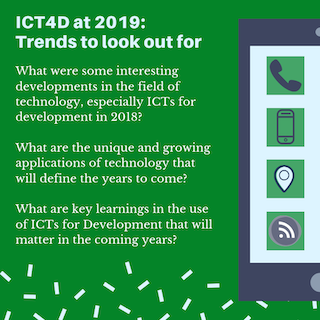
As we step into 2019 in earnest, it is time for some reflection: What were some interesting developments in the field of technology, especially ICTs, for development in 2018? What are the most unique and growing applications of technology that will define the years to come? And finally, what are some key learnings of ICTs for Development that we should keep in mind as we go along?


Noteworthy developments from the recent past

  1. Vernacular tech is growing, but more is needed to make the content localised, relevant and optimised for minimum usage of data or space without compromising on quality. Ankur Capital writes on this key trend: https://www.ankurcapital.com/post/vernacular-tech-changing-business-landscape-in-india-for-next-billion-users
  2. Even as data usage grows, offline sharing of apps, content and files is a trend that is popular among semi-urban and rural areas of India that are still in the shadows of reliable mobile data connectivity. Arundhati Ramanathan writes for The Ken on how Google is trying to tap into P2P sharing of apps, currently dominated by SHAREit (the piece requires sign-up to read): https://the-ken.com/story/google-wants-its-share-of-shareits-sideloading-pie/
  3. An interesting new development is that of vernacular ‘conversational agents’ to address the needs of people with low literacy and technology experience for credible information and counsel on various topics. Read about Farm Chat, a conversational agent in Hindi for farmers: https://homes.cs.washington.edu/~mohitj/pdfs/j2-imwut-2018.pdf
Upcoming applications of technology that hold promise
Digital technologies, including ICTs, have been successful in measuring, delivering and monitoring health services in India, but here are some new areas that are opening up.
  1. Satellite imaging, IoT and big data for improving farm yields, strengthening climate change resilience, agriculture financing, insurance, etc. Check out Oxen Farms, an IIT Kanpur incubated start-up that incorporates these technologies in farms across central and northern states of India.
  2. There is growing deployment of technology and media for ensuring rights, with their role in contributing to transparency and accountability becoming centre stage. Read our colleague Orlanda Ruthven’s article on The Wire on our platform Saajha Manch, which provides a database of accounts by workers in NCR of the kinds of violation and enforcement failure encountered daily.
  3. Children from low-income families often end up trailing behind in schools because their parents, often with limited education themselves, are unable to help the children with early education. Start-ups such as Saarthi Education and Dost Education are leveraging simple ICTs to equip parents to better engage in their children’s early education and development.
Pointers to remember as we look to use technology for good in the coming years
  1. Technology is not good or bad in and of itself, but any technology can be misused if we don’t put in place robust structures for its use and governance. Read what our co-founder Aaditeshwar Seth has to say about ensuring responsible outcomes from technology, including some possible governance structures to explore: http://www.cse.iitd.ernet.in/~aseth/processes-to-manage-technology.pdf
  2. Even as we herald the coming-of-age of mobile technologies in India, there’s a substantial gap in people’s access to and ability to tap the multiple benefits it can offer, especially among women. This paper from Harvard Kennedy School examines the intersections between economic and normative barriers that influence women’s ownership of mobile phones – and therefore will influence how we develop programmes to engage and benefit women.
  3. Does access to technology mean its benefits can be realised? Our experience showed that there’s more to it – technology adoption doesn’t happen instantaneously. Skill building through offline methods is crucial here, and these need to be low-cost methods. Read about how we can build stable, self-governing and reproducible structures in offline skilling – based on our experience with Mobile Vaani’s strategy of creating volunteer clubs: http://www.cse.iitd.ernet.in/~aseth/camera-ready-1598-4953-1-PB.pdf
  4. With our project JEEViKA Mobile Vaani, we managed to bring in women who didn’t have access to, or regularly use, mobile phones and shared messages on improving maternal nutrition. Here is a paper that was presented at Information and Communication
    Technologies and Development (ICTD) 2019 on our experiences in building technology adoption among women through this project: http://www.cse.iitd.ernet.in/~aseth/genderNtechICTD19-1909-01.pdf