


by Vani Viswanathan
Not only are wages in the country low in general, women get even lower wages than men. As opinions from listeners of Mobile Vaani show, this makes it difficult for women to contribute better in running their households, and could also be a disincentive keeping women from seeking employment.
Over the past year, we have been grappling with why women’s participation in the labour force has dropped from 35% in 1991 to 27% in 2017. This is especially confusing since the 2011 National Sample Survey found that one-third of women in urban India and half of the women in rural India – who are engaged mainly in housework – want paying jobs. Some experts have pointed that this is expected in an economy where women are gradually pursuing higher education or are not “required” to work because income levels have stabilised. But others have highlighted the role of social norms: women’s responsibilities at the home front, and the “shame” that comes with having a working woman in the family, while others look at how appropriate opportunities are not available, be it for women with medium levels of education, or for those looking for labour-intensive agriculture and non-agriculture activities.
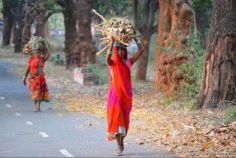
Speaking from Kharijama village in Chandi block, Bihar, all of 50 kilometres from the state capital Patna, Meena Devi is probably not aware of these macroeconomic discussions around participation of women such as herself in India’s economy. An agricultural labourer, she is up in arms against the fact that she is paid only 200 rupees while men get 400-500 rupees for the same work on the farm.
“When I ask the landowner why they are paying me less, they said that women work less than men, and so we must receive at least 50 rupees than men for the same work.”
Meena Devi is one of the millions who listen to Mobile Vaani, which has 20 rural clubs in Bihar, Jharkhand and Madhya Pradesh, and urban clubs in Delhi/NCR, Indore (Madhya Pradesh), and Chennai and Dindigul (Tamil Nadu). Over the last few months, we have been encouraging more women (and men) to speak up about wage discrimination due to gender, and here we discuss some of their responses.
Wage labour in India is particularly exploitative: not only are low wages the norm, women get the worse end of it, both in informal and formal sectors. Low wages could deter women from taking up work – if women have to fight social norms and cultural strictures just to get a job that pays them poorly, many might not find it worth their effort. On the other hand, given the distressingly low incomes that force women to work, women enter the vicious circle of accepting low wages as they want any income they can get.
Listen to Meena Devi’s opinion here:
“Women and men are made differently”
Even as the NSSO states that wage discrimination in the informal sector has reduced, at 20%, this difference between pay for women and men is still large. Importantly, this figure does not include significant portions of work related to agriculture, which employs 60% of Indian women in the workforce. Studies have shown that wage discrimination due to gender is much higher in the informal sector in India, with the study ‘Wage Discrimination in India’s Informal Labour Markets: Exploring the Impact of Caste and Gender’ highlighting that the agriculture sector is perhaps one of the worst offenders.
True to form, several men who responded to Mobile Vaani’s prompt to our Jharkhand listeners about wage discrimination between women and men, said that it is unfair to expect women to be paid the same as men when “clearly, they are not capable of working as hard as men”. Some relied on the simplistic argument of women’s bodies being made differently from men. One of them wondered, “A farmer ploughs the land, does a woman do that? Why, then, should she get the same pay?”
Even as we should question the use of the word “farmer” to refer to a man only, other men and women who shared their opinions actively challenged these ideas, stating that even if women’s bodies are made differently, there was no difference in their capabilities with regard to farm labour, or their outputs in the field.
“Our patriarchal society is the reason behind women getting less wages than men for the same work,” shared one listener, urging the government to come up with laws and regulations to ensure equal wages for equal work. Another wondered that it was unfortunate that this situation prevails to this day, 70 years after the country’s independence.
Listen to men talking about women receiving lower wages here:
Women who spoke to Mobile Vaani highlighted the many ways in which this was unfair: besides the outright discrimination, this ignored the fact that women had to run households with less money, something that especially got critical in women-headed households. And women-headed households are increasingly growing in number, thanks no less to the massive rural outmigration of men due to declining agricultural incomes and a higher focus on services and manufacturing.
Listen to Vrinda Devi talking about women’s double burden of managing home and employment, and the difficulty with earning lower wages than men for the same work:
Migration, informal labour and wage exploitation
Over the last decade, women’s migrating has increased significantly. The number of women migrating for work increased by 101% from 2001 to 2011 – double the rate of men’s migration, which increased 49%. Urban areas, which have grown to accommodate nearly one-third of Indian citizens, employ large numbers of women under exploitative circumstances, especially in the construction and garments industries.
Shabana, living in Kapashera, Delhi, is a migrant woman in one such enterprise. Pushed to migrate to Delhi from Muzaffarpur, Bihar, Shabana cuts thread for a garments business on a contractual basis. In her list of complaints – ranging from the irregularity of the work to the irrational prices for utilities that her landlord imposes – is the fact that men get more money for the same work she does: 260 rupees for 10 hours of cutting thread, compared to the 200 rupees that she gets.
“Contracts are erratic; even payment under these contracts varies from 180 rupees to 200 or 220 for the same work. I get work for 10 days a month, at most. If I could get a job directly with the company, I would get a higher salary.”
Many women – and men – echoed these thoughts about the exploitative wage and employment terms in casual labour. Several men spoke with Mobile Vaani about women being made to work overtime (and not compensated for these), working till nights even over the weekends. “Their factory gates are locked so that they don’t leave,” said Vinod, also from Kapashera, Delhi. Sunita from Noida, Uttar Pradesh described that when she took up a new job, her employers told her that she would be paid after eight days for her work, but her colleagues at her new workplace told her that many of them hadn’t been paid even for a month. “I left the job the very next day,” she said.
Most of these women are migrants to Delhi from various parts of northern India, signalling distress migration due to their inability to afford two square meals a day. Even though Shabana is struggling with the notorious lack of regulation in the urban casual labour economy, her life, it seems, is better because of her migration to Delhi. “I had to migrate because it was getting difficult to run the household back in Bihar. My child was going hungry for days together. Here, at least I am able to contribute to the household expenses…”
Listen to Shabana’s opinions here:
What is the way forward?
The Code on Wages, 2017 was introduced in the Lok Sabha in August 2017, proposing minimum wages which states can define. This drew swift resistance from trade unions for proposing to make redundant several existing wage/labour laws, including the Equal Remuneration Act, 1976, and replacing them with diluted provisions.
At Gram Vaani, in the meantime, we are working at several levels to attempt to reduce incidences of wage discrimination due to gender. At villages, for instance, we have created a pool of volunteers who assist women in the legal/bureaucratic process to claim their entitlements. In several cities and towns such as Delhi and the extended National Capital Region, Indore, Chennai, Dindigul and Tirupur, we have partnered with local unions and activists to give low-wage industrial workers a voice. This project, Brochure_shramik vaani v2, has platforms in each of these cities/towns that enable sharing of information related to laws and entitlements, help with filing complaints by creating a pool of volunteers and drive collective action.
While we work on laws, entitlements and awareness, this needs to be accompanied by attitude change on the ground. Quite a few of the men from Jharkhand who shared their thoughts on Mobile Vaani believed that women just have to be louder and bolder in asking for equal wages; they did not question the men who were contributing to the issue in the first place. We know from our female listeners’ opinions that they do ask, but they are shut down, or in some cases, beaten up or fired, when they do so. Equal pay for equal work is a human – and constitutional – right, and women shouldn’t have to fight this battle alone.
In the next article in this series, we will examine the various issues that women face as employees in garments industries in cities across India.