

Our Blog

Gramvaani has a rich history of developing mixed media content that includes audio-video stories, developing reports based on surveys conducted with population cut off from mainstream media channels and publishing research papers that helps in changing the way policies are designed for various schemes. Our blog section is curation of those different types of content.

Community Outreach & Empowerment

admin 5 July 2021

Studies have shown that almost 80% of the Indian population is offline for most practical purposes; and a big percentage of this group does not have access to mainstream media channels either (like newspapers, radio, and television). Given this, at Gram Vaani, we believe in using appropriate technology and people driven processes to build participatory media networks that can empower communities. Our Theory of Change has organically evolved from the ground up and is based on our experience of working in the rural Information, Communication and Technology space over the last few years.
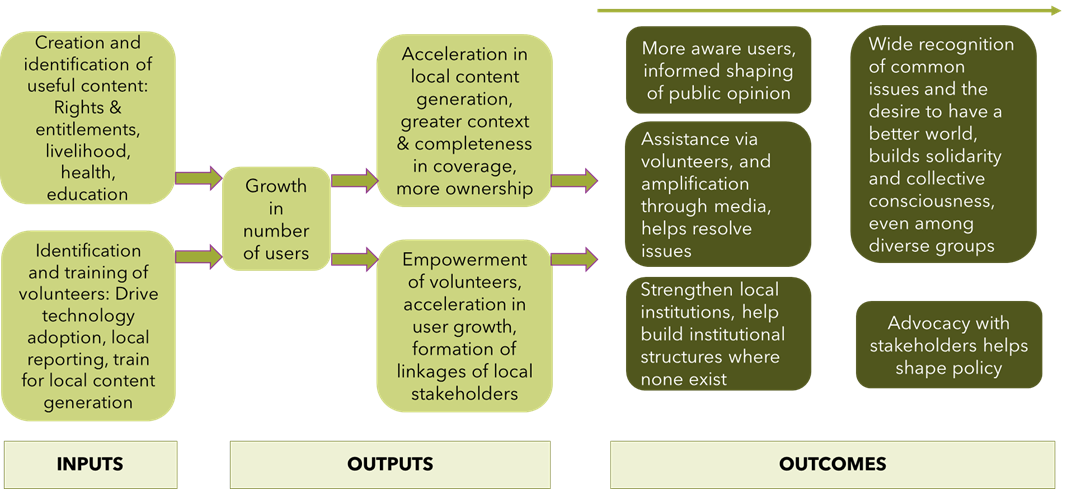
The following figure depicts how Mobile Vaani leads to –

  • improved awareness about rights and entitlements,
  • demand for services (individual/family/collective demand), and subsequently
  • improvement in the self and collective action
  • better accountability of various stakeholders

Our Theory of Change reflects how we build and strengthen social accountability of stakeholders and ensure transparency in the governance processes. For instance, government institutions in India offer multiple social security entitlements to rural and urban low-income communities such as the Public Distribution System, National Social Assistance Programme (NSAP), Direct Benefit Transfer-linked schemes including PM-KISAN, Jan Dhan, MGNREGA, BOCW, and Provident Fund. Yet, there has been extensive documentation of exclusion of deserving people from availing these social protection measures. These excluded individuals are often encouraged to record their grievances on Mobile Vaani. The Gram Vaani team then ensures that these grievances are handled by a network of community volunteers, who interact with concerned government or panchayat officials or provide online assistance to the people to help solve their problems.

Mobile Vaani platforms can reach ‘media dark’ areas and help in bridging the gap left by communication that relies on mass media. The IVR system engages listeners in real time and can be used as an indicator to understand changes in mindset brought about by the programmes.
As a community media platform, Mobile Vaani heavily emphasizes on creating and featuring new and engaging content to retain its users so that they feel motivated to access the platform on a regular basis. Content is created in the studio by our content team, or is user-generated, reactions, feedback, and experiences shared by users who listen to our published content on the Mobile Vaani platforms. There is a mix of contextual content that is local and relatable, and complete content – with an attempt to get a 360-degree view of a particular issue, from community members to officials, for instance. This mix effectively helps us reach out to diverse communities with information, opinions and perspectives on issues that matter to them.

https://rootlocalhost.net/ slot demo slot gacor 2026 iboplay slot toto slot gacor bandar bola iboplay roda777 slot pulsa snicasino iboplay iboplay roda777 snicasino slot online iboplay iboplay slot slot online slot toto snicasino slot terbaik slot gacor https://jpf.fkip.unila.ac.id/index.php/JPF/libraryFiles/downloadPublic/3 https://jpf.fkip.unila.ac.id/index.php/JPF/libraryFiles/downloadPublic/4 https://jpf.fkip.unila.ac.id/index.php/JPF/libraryFiles/downloadPublic/5 https://jpf.fkip.unila.ac.id/index.php/JPF/libraryFiles/downloadPublic/6 https://jpf.fkip.unila.ac.id/index.php/JPF/libraryFiles/downloadPublic/7 https://jpf.fkip.unila.ac.id/index.php/JPF/libraryFiles/downloadPublic/8 https://jpf.fkip.unila.ac.id/index.php/JPF/libraryFiles/downloadPublic/9 https://jpf.fkip.unila.ac.id/index.php/JPF/libraryFiles/downloadPublic/10 https://jpf.fkip.unila.ac.id/index.php/JPF/libraryFiles/downloadPublic/11 https://jpf.fkip.unila.ac.id/index.php/JPF/libraryFiles/downloadPublic/12 https://jpf.fkip.unila.ac.id/index.php/JPF/libraryFiles/downloadPublic/13 https://jpf.fkip.unila.ac.id/index.php/JPF/libraryFiles/downloadPublic/14 https://jpf.fkip.unila.ac.id/index.php/JPF/libraryFiles/downloadPublic/15 https://jpf.fkip.unila.ac.id/index.php/JPF/libraryFiles/downloadPublic/16 https://journal.ipb.ac.id/cbj/libraryFiles/downloadPublic/1380 https://journal.ipb.ac.id/cbj/libraryFiles/downloadPublic/1381 https://journal.ipb.ac.id/cbj/libraryFiles/downloadPublic/1382 https://journal.ipb.ac.id/cbj/libraryFiles/downloadPublic/1383 https://journal.ipb.ac.id/cbj/libraryFiles/downloadPublic/1384 https://journal.ipb.ac.id/cbj/libraryFiles/downloadPublic/1385 https://journal.ipb.ac.id/cbj/libraryFiles/downloadPublic/1386 https://journal.ipb.ac.id/cbj/libraryFiles/downloadPublic/1387 https://journal.ipb.ac.id/cbj/libraryFiles/downloadPublic/1388 https://journal.ipb.ac.id/cbj/libraryFiles/downloadPublic/1389 https://journal.ipb.ac.id/cbj/libraryFiles/downloadPublic/1390 https://journal.ipb.ac.id/cbj/libraryFiles/downloadPublic/1391 https://journal.ipb.ac.id/cbj/libraryFiles/downloadPublic/1392 https://journal.ipb.ac.id/cbj/libraryFiles/downloadPublic/1393 https://journal.ipb.ac.id/cbj/libraryFiles/downloadPublic/1411 https://journal.ipb.ac.id/cbj/libraryFiles/downloadPublic/1412 https://journal.ipb.ac.id/cbj/libraryFiles/downloadPublic/1413 https://journal.ipb.ac.id/cbj/libraryFiles/downloadPublic/1414 https://journal.ipb.ac.id/cbj/libraryFiles/downloadPublic/1415 https://journal.ipb.ac.id/cbj/libraryFiles/downloadPublic/1416 https://journal.ipb.ac.id/cbj/libraryFiles/downloadPublic/1417 https://journal.ipb.ac.id/cbj/libraryFiles/downloadPublic/1418 https://journal.ipb.ac.id/cbj/libraryFiles/downloadPublic/1420 https://journal.ipb.ac.id/cbj/libraryFiles/downloadPublic/1421 https://journal.ipb.ac.id/cbj/libraryFiles/downloadPublic/1422 https://journal.ipb.ac.id/cbj/libraryFiles/downloadPublic/1423 https://journal.ipb.ac.id/cbj/libraryFiles/downloadPublic/1425 https://journal.ipb.ac.id/cbj/libraryFiles/downloadPublic/1427 https://www.kirobo.io/konten/pendekatan-formalitas-efisiensi-terhadap-simbol-mahjong-ways.html https://www.kirobo.io/konten/interpolasi-bias-distribusi-hasil-kemenangan.html https://www.kirobo.io/konten/dinamika-jam-update-server-dalam-perubahan-pola-mahjong-ways.html https://www.kirobo.io/konten/studi-kasus-mengenai-strategi-keberhasilan-pola-infrastruktur-modern.html https://www.kirobo.io/konten/strategi-mahjong-ways-dalam-evaluasi-stabilitas-pola-permainan.html https://journal.ipb.ac.id/cbj/libraryFiles/downloadPublic/1485 https://journal.ipb.ac.id/cbj/libraryFiles/downloadPublic/1486 https://journal.ipb.ac.id/cbj/libraryFiles/downloadPublic/1487 https://journal.ipb.ac.id/cbj/libraryFiles/downloadPublic/1488 https://journal.ipb.ac.id/cbj/libraryFiles/downloadPublic/1489 https://journal.ipb.ac.id/cbj/libraryFiles/downloadPublic/1490 https://journal.ipb.ac.id/cbj/libraryFiles/downloadPublic/1491 https://journal.ipb.ac.id/cbj/libraryFiles/downloadPublic/1492 https://journal.ipb.ac.id/cbj/libraryFiles/downloadPublic/1493 https://journal.ipb.ac.id/cbj/libraryFiles/downloadPublic/1494 https://journal.ipb.ac.id/cbj/libraryFiles/downloadPublic/1495 https://journal.ipb.ac.id/cbj/libraryFiles/downloadPublic/1496 https://journal.ipb.ac.id/cbj/libraryFiles/downloadPublic/1497 https://journal.ipb.ac.id/cbj/libraryFiles/downloadPublic/1498