India has the highest number of maternal deaths in the world, an estimated 44,000 deaths every year. Despite 75% decline in the Maternal Mortality Ratio in India between 1990 and 2015, the maternal health crisis is far from over. Another equally severe but less talked about issue is maternity morbidity which includes all conditions attributed or aggravated by pregnancy and child birth. Different studies estimate that for every maternal death, there are at least 20 to 100 women living with maternal morbidity. The fact that the majority of these conditions can be prevented by providing adequate and timely health care is even more saddening.
Alongside medical reasons, limited awareness about provisions and practices, limited or poor access to health care systems, the root causes of ill-health of women in India lie in the low social status accorded to women. Another reason for this dire condition is the high proportion of girls who get married at a young age. Maternal deaths related to pregnancy and childbirth is an important component of mortality for girls aged 15–19 worldwide. Spacing and number of pregnancies, inadequate nutrition and lack of access to quality health care are some other causes for the high maternal mortality rate. Knowledge about and access to medical care facilities, play a critical role in ensuring safe pregnancy and delivery.
With this context in mind Oxfam India wanted to engage rural communities in discussing some of the above mentioned issues associated to Maternal Health and the campaign was executed in the states of Jharkhand, Bihar, Madhya Pradesh, Odisha, Uttarakhand and Uttar Pradesh through Mobile Vaani network of three Community Radio Stations and four Mobile Vaani numbers. This campaign was aimed not only at providing information to the listeners about maternal health, but also to initiate a discussion among them and seek their opinion on the issue.
The campaign was spread over a time span of eight weeks and as per the content plan, the first and the last weeks were dedicated to conduct surveys to understand the prevailing awareness and perceptions about issues related to maternal health and assess any change in the behaviour of the respondents by the end of the campaign. The remaining six weeks in between the surveys were utilized to provide information to and elicit responses from the callers. The four episodes were in drama format for better user engagement and induce behavioural change.
Background: In India, details related to immunization tend to be recorded manually on multiple paper-based registers. Their paper-based nature makes processes to compile and digitize the data extremely inefficient. Not having timely and accurate data makes it difficult for health planners to take steps to improve coverage and follow-up of immunization.
The solution: SnapVaxx is a Gram Vaani solution that frontline workers can use to scan immunization records that families have for their children, using smartphone cameras.
The expected result: Improved data accuracy, timeliness and completeness. The data will further be used for efficient supply chain monitoring, beneficiary engagement and communication.
***
Immunization of children in India is a task that involves a range of frontline workers, including the Accredited Social Health Activist (ASHAs), Auxiliary Nurses and Midwives (ANMs) andAnganwadi Workers (AWWs), who raise awareness around immunization, keep track of pregnancies and childbirths (and therefore children in need of vaccination), mobilise parents to get their children vaccinated and finally administer vaccines themselves.
Despite the efforts of these workers and programmes by governments to boost immunization of children, there are several issues that make this difficult.
First, many families in rural India, especially those living close to or below the poverty line, migrate seasonally out of their villages to towns and cities across India to make ends meet. In this process, tracking immunization becomes difficult. Additionally, documents that parents hold which record their child’s immunization history get lost or damaged, making tracking and follow-up even tougher.
Second, there are several registers holding information on children in the village that are in need of vaccination, maintained by frontline workers. But these records are mostly handwritten and aren’t easy to verify. The ASHA worker, who is in charge of vaccinations, might sometimes not have the full list of children in the villages she’s responsible for, and tracking this information is a time-consuming process. Not having this information means government health departments aren’t able to estimate the adequate number of vaccines required for the villages.
Third, the number of children who need vaccinations/have received them recently does not go to block-level health planners in real time – often, by the time this data, compiled by the frontline workers, is digitized at the nearest primary health centre, considerable time has passed. This data, useful to know whether all children have received their appropriate vaccinations, and the status of the village’s immunization history, the supply of vaccines, any urgent steps required, etc., is of little actionable use by this time.
The lack of verifiable and accurate data that is also available real-time takes the country farther from immunization equity, as it becomes difficult to track and cover gaps in immunization of children based on their economic, caste, class, regional or religious status – which could hamper governments’ efforts to design and implement special programmes to ensure immunization reaches every child across the country.
Gram Vaani and Professor Mira Johri from the University of Montreal Hospital Research Centre (CRCHUM) have collaborated to attempt to remedy these issues on immunization-related data through digitization, relying on the Mother and Child Protection (MCP) cards that are already in use. This MCP card is given to the family of every newborn child and includes a page that requires the ASHA worker to list in writing every vaccination given to the child and the date it was administered.
The intervention starts with adding a QR code to the MCP card, which will help give each child a ‘unique’ identifier with the child’s date of birth, enabling the child’s age (and therefore which vaccinations are to be administered when) to be easily tagged. Gram Vaani has developed in house SnapVaxx, the technology to scan the immunization records in the MCP cards. Health workers will be trained to scan the MCP card using our app, Tika Vaani. Scanning the QR code will ‘identify’ the child, and scanning the immunization page will identify which vaccines have been administered to the child, and when. This information will be directly accessible on a dashboard by block and district level health officials on a real-time basis, as opposed to waiting for several months.
A field worker tests the solution
What does it mean to have this data processed quickly? The data is accurate, as it doesn’t rely on someone in the primary health centre, far removed from the on-ground immunization process, inputting the records into the system. The data is complete – if the parent has the MCP card, no matter where the child is immunized, the history of the child’s immunization journey is tracked. This becomes vital in situations where families migrate often for their livelihood. As such, tedious registers that had to be maintained by the frontline community workers – which could have inaccuracies of different kinds, for various reasons – are now replaced by digital records.
The digitization process is useful for parents as well. The data collected using Tika Vaani helps Gram Vaani systems send automated reminders to families on their mobile phones close to the dates when the next round of immunization is happening in their villages. These customized messages – targeting only families with children who are due to get vaccines that month – will also ensure that parents do not just treat it as any other regular message but pay attention to it.
SnapVaxx is a grantee under the Biotechnology Industry Research Assistance Council (BIRAC), set up by Department of Biotechnology (DBT), Government of India, as a part of the Grand Challenges India program titled ‘Immunization Data: Innovating for Action (IDIA)’, to focus on encouraging innovation in the collection and management of immunization data in India. It is also a winner of the Bill & Melinda Gates Foundation’s Grand Challenges Explorations Round 22 for undertaking a validation study of the optical scanning data outputs. In addition to this, the solution is one of the eight recipients of support from UNICEF’s Innovation Fund. Support from these organisations is helping us bring in international expertise in the technology, in pilots, scaling up, and evaluation. For more information, visit tikavaani.org.
Infotainment empowers! Listen to Pooja Kumari who shares that she stopped her friend’s forced early marriage by calling 1098. She got this idea from a segment on Meri Awaz Meri Pehchan, a community media platform on women’s and girls’ issues. When Pooja, a 6th grader in Bihar, learnt of her friend’s early marriage, she tried to convince her friend’s mother to stop it. But when she disagreed, Pooja remembered a story she heard on our IVR Meri Awaz Meri Pehchan & called ChildLine (1098) to report it. The wedding was stopped.
Women share how they are able to express themselves, get support for livelihood and social security issues through Meri Awaz Meri Pehchaan. This Mobile Vaani program has helped women in rural India inspire each other, gain confidence and learn about & demand their rights.
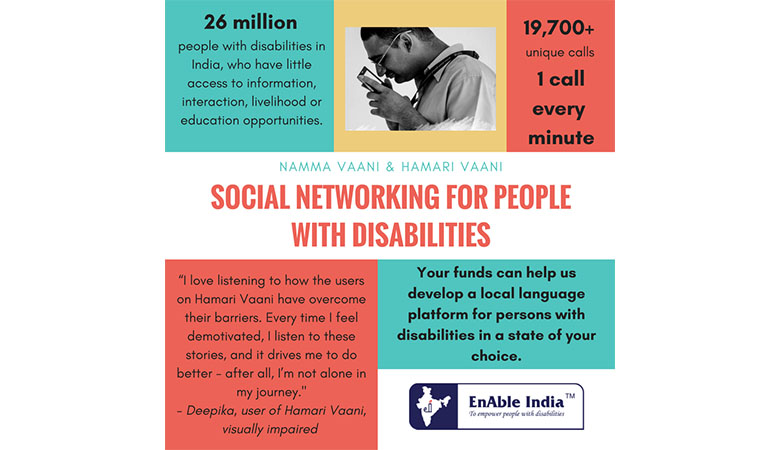
In collaboration with Enable India, we developed an IVRS service specifically for persons with disabilities – Namma Vaani in Karnataka, and Hamaari Vaani in Hindi-speaking states. In less than 2 years, this popular ‘social network’ has been used by over 15,000 people with disabilities, and 300 livelihood opportunities and vocational tips have been shared. Read more about this initiative here.
Here is our plan to take this initiative further. Write to us at contact@gramvaani.org to know more or contribute to co-funding this project!
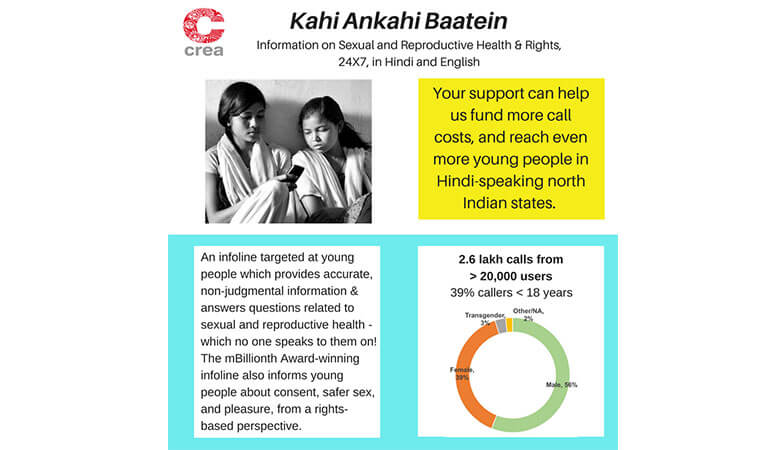
Young people have many questions on their body, relationships, their identities and safer sex, which are, unfortunately, taboo subjects to talk about in India. CREA’s Kahi Ankahi Baatein is a Hindi/English, 24X7 infoline that answers these questions in a safe, non-judgmental way, and over 20,000 people have made over 2.6 lakh calls.
Here is our plan to take this project further. Write to us at contact@gramvaani.org to know more or contribute to co-funding this project!
Gram Vaani is the technical partner of Kahi Ankahi Baatein, an infoline run by CREA with the support of other organisations, that provides to information on sexual and reproductive health and rights. Here is an article about the infoline from 2015, when it was launched. Originally published here.
By Friday, November 6, 2015 – 13:17
CREA, a human rights organisation, recently launched an info line ‘Kahi Ankahi Baatein.’ Love Matters interviewed CREA’s programme co-ordinator Anubha Singh to find out more about it.
Anubha Singh is a programme co-ordiantor with CREA that works for women and human rights. Their office is based in New Delhi.
LM: Why is there a need for info line about sexual health in India?
A: Mostly in India, rights based information on sexual and reproductive health and rights (SRHR) is distributed either through training or associations within the development sector. There are very few services that provide information to the Hindi speaking belts of remote India. CREA wants to ensure that an accessible service is introduced to them.
There are many misconceptions in the minds of young people and rural pockets have marginalised discussions on sexuality. Our aim is to create a safe platform to share questions, suggestions and thoughts about SRHR while engaging with technology.
A: This info line is a free of cost service based on IVR (interactive voice response) technology found in mobile phones. It doesn’t require internet or any application to run. The user just needs to give a missed call and can hear three to five minutes informational audio episodes on the call.
Any phone user can leave a missed call on 09266292662 and expect a call back. However, it is not a helpline and live counselling isn’t a part of the project. There are pre-recorded audio sets that play according to user response.
LM: What kind of information do you give out?
A: Our recordings are saved in two separate channels. The campaign channel on the info line includes two new episodes every week. Short audios with expert interviews, testimonials, suggestions and advice are aired every Friday and a drama series on the same topic is presented on Tuesday.
The other user-response-based channel ‘Jaankari’ has static recordings on various sexual health topics. There is also an option to record queries from users. We reserve a special slot in the last segment to respond queries.
LM: What are the core issues you are focusing on through this info line?
A: Every month, we choose a theme for our campaign channel. Last month it was abortion, this month we are discussing panchayat elections. We have decided to bank on most common topics such as misconceptions about masturbation, female masturbation and reproductive organs.
We have also structured an advisory panel for monthly themes and radio content. Advisors from different organisations, including Love Matters, participate in discussions and help generate content. We also have other SRHR organisations like TARSHI, Samarthyam and Gurgaon Ki Awaaz supporting us.
LM: Is this info line a safe and confidential service?
A: Our technology partner, Graamvani, has previously implemented the IVR system successfully where access to data is limited to very few people working on the project. Since the topics we deal with are very sensitive, we make sure that the privacy of our users is ensured. We even club queries according to the theme and address them collectively, instead of addressing it to the specific user.
LM: What are the challenges you face while running this service?
A: The biggest challenge that we face every month is to come up with the right topic. Our advisory panel brainstorms on several ideas. We also collect surveys from users. Then, we move ahead to finalise the theme and content.
Disseminating correct, rights-based information to our users is our next challenge. We craft our episodes in a way that every caller can understand the content. We received more than two thousand calls in the first month. We are looking forward to promoting this service through offline outreach programmes.
If you need information related to sexual health, don’t hesitate to give a missed call on 09266292662. The service runs in Hindi and English.